

Benedict Arnold's Boot
Also: Last chance to join me online in 2025!

There is, in upstate New York, a monument to Benedict Arnold’s leg.
Benedict Arnold is infamous now as a traitor to the American cause during the Revolutionary War. Before he defected, however, he was considered one of the best and most successful soldiers in the Continental Army.
Arnold was something of an unhappy camper throughout his life. During the war, he complained that he was constantly being passed over for promotion, and that other officers were often given credit for his accomplishments. Before and after the revolution, he was an unpopular businessman, even outside the US.

Arnold’s unhappiness reached its peak during the two Battles of Saratoga. Arnold fought well as a field commander during the first battle, but he and Major General Horatio Gates, who was in charge, argued so much they ended up screaming at each other. Gates relieved Arnold of command, but Arnold ignored him. In the second battle, he disobeyed Gates’s orders and led more attacks on the British.
Here’s where his leg comes in. During that second engagement, Benedict Arnold was shot in his left leg. His left leg had already been wounded twice before while fighting for independence, first during the invasion of Quebec in 1775, and again at the Battle of Ridgefield in 1777. To make matters worse, Arnold’s horse was shot and fell over on him at Saratoga, crushing Arnold’s already re-wounded left leg.
Arnold chose to have his leg reset rather than amputated, but it wasn’t set right. Adding insult to injury, General Gates was so mad at Arnold for disobeying him that he left Benedict Arnold entirely out of his battle report to the Continental Congress, robbing Arnold of his glory.

Arnold was bitter about his accumulated leg injuries, and his long recuperation gave him time to dwell on all the ways his revolutionary peers had slighted him—whether real or not. It also gave his loyalist wife Peggy Shippen a chance to finally convince him to turn traitor and work for the British. Through her connections, British General Henry Clinton offered Benedict Arnold £20,000—the equivalent today of more than three million dollars—for the capture of the American fort at West Point.
Arnold requested command of West Point from his friend George Washington, and then proceeded to weaken its defenses in preparation for a British attack. When a British spy was captured with a letter from Benedict Arnold detailing how the British could take the fort, the jig was up. Arnold fled to British occupied New York City, officially flipped sides, and was given a commission in the British Army. He spent the rest of the war fighting against the Continental Army, leading successful raids in Richmond, Virginia, and New London, Connecticut. (Talk about holding a grudge!)

Years later, a four-sided obelisk was erected as a monument to the soldiers who fought at the Battles of Saratoga. Three of the sides feature niches with statues of the patriots who led the battle—General Philip Schuyler, Colonel Daniel Morgan, and General Horatio Gates. The fourth niche in the monument, which represents Benedict Arnold’s contributions in the battle, was intentionally left empty. “Signifying,” the National Park Service says, “General Benedict Arnold’s heroism in 1777, overshadowed by his late treachery.”
Local historians still wanted to honor Arnold’s deeds at the Battles of Saratoga without honoring the man himself. But how?
For inspiration, they looked to a famous story about Benedict Arnold after the war. While he was living in London, England, Arnold ran into a fellow American. Arnold asked the man: what do Americans think of me now, seeing as I once was one of the fiercest fighters for American independence? The man told him that America would happily make a monument out of Arnold’s wounded leg, and hang the rest of his body in effigy. (Ha! Looks like grudges work both ways, Benedict.)

That random American’s words eventually became a reality. “The leg was the only part of Arnold not to later turn traitor,” the Saratoga Monument Association decided when conceiving the nameless memorial in 1887, “and since it was sacrificed in winning the Battle of Saratoga, it should be commemorated.”
That is why there is a statute of Benedict Arnold’s boot—and not Benedict Arnold himself—in Saratoga, New York.
I don’t think Benedict Arnold or his boot are going to make it into the book I’m writing about the American Revolution, so I had to share that amazing story here!
Don’t miss my last virtual school visit of 2025
Once a month during the school year I hop online to talk for an hour about my books, my background, and my writing process. I give a presentation for the first half hour, and then spend the next thirty minutes answering questions from attendees. Whether you’re watching from home, a classroom, or an auditorium, there’s no fee to attend, and no limit on how many people can watch.
There is only one more virtual school visit left in 2025! Click the link below to register:
Tuesday, December 16, 2024 at 1pm ET, 12pm CT, 11am MT, 10am PT
Each virtual event is recorded, and will be available for at least a month afterward to anyone with the link. You can even sign up and view a presentation after the fact! Regardless of how or when you watch, I hope you’ll tune in.
If you can’t make it this time, fear not—I’ll be back with more virtual school visits in the spring.
Last chance to order signed books for the holidays!
You’re also running out of time to get signed books delivered by the holidays. If you’re interested, Green Bean Books here in Portland, Oregon is the place to go. Visit the special Alan Gratz page on their web site, or give them a call. You can even ask for me to personalize the books. (Like, “To Benedict,” or “To Arnold.” You know, just as examples.) But don’t delay! You know how the postal system gets this time of year…
What I’m reading
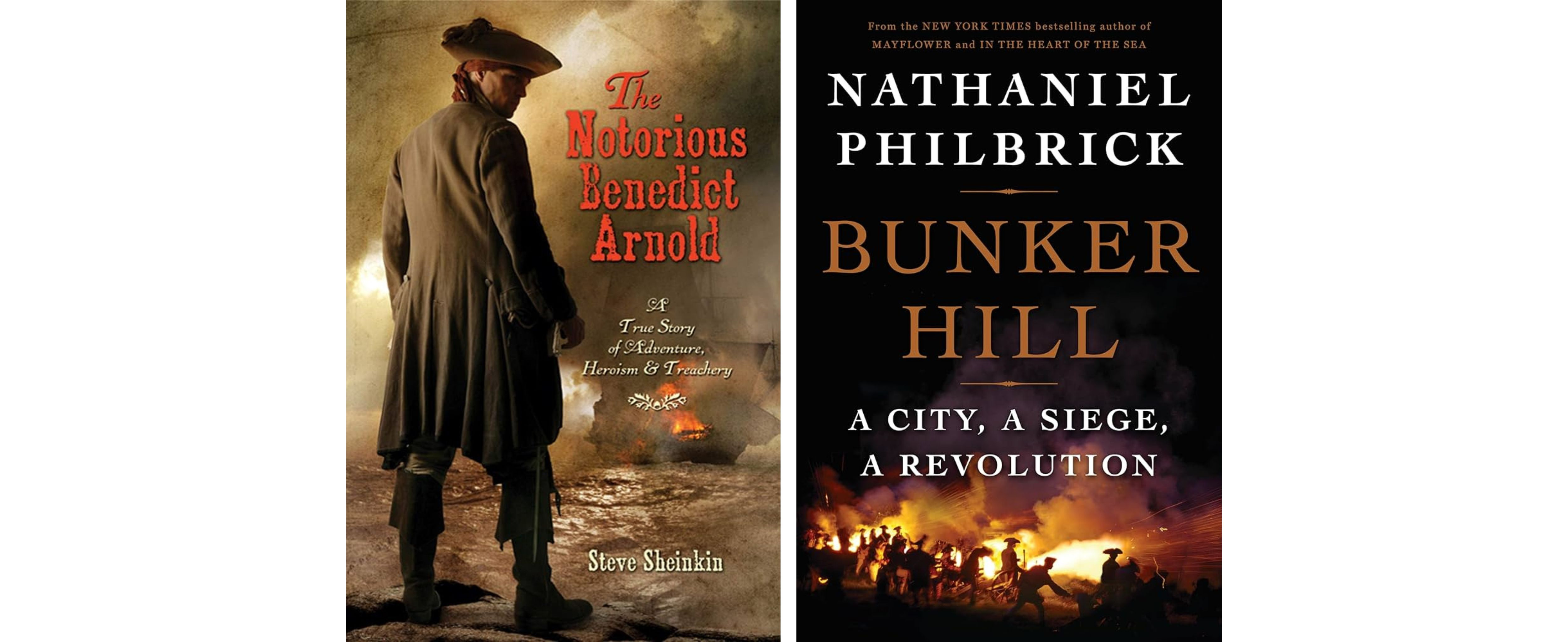
Is it any surprise that I’m reading books about the American Revolution right now? Here are two I love. The first, written for kids, is Steve Sheinkin’s The Notorious Benedict Arnold. The second, written for adults, is Nathaniel Philbrick’s Bunker Hill: A City, a Siege, a Revolution. If my story of Benedict Arnold’s boot has you itching for more revolutionary tales, pick these up. You won’t be disappointed!
That’s it for this month! If you liked this newsletter, please share it online, or with anyone you think would be interested:
And if you aren’t already a subscriber and you’d like to be, you can sign up here:
I’ll leave you with this historically accurate reenactment of George Washington confronting Benedict Arnold after he learns of his betrayal:
Happy holidays, and happy new year!
A Revolutionary War story from you! I'm intrigued!