

Revolutionary Moon
Shining a little light on Paul Revere's Midnight Ride
You know the story: On the night of April 18, 1775, American patriot Paul Revere left Boston on a rowboat, landed in Cambridge, and then set off on horseback for Lexington and Concord on his famous Midnight Ride. His mission: warn everyone along the Concord Road that British soldiers were coming up fast behind him and aiming to make trouble.
Eighty-five years later, Henry Wadsworth Longfellow wrote a famous poem about it called “Paul Revere’s Ride.” Seventy-one years after that, American artist Grant Wood (he of American Gothic fame), painted this awesome picture inspired by Longfellow’s poem:

The ride has inspired lots of art, in fact. Here’s three more, from different eras:
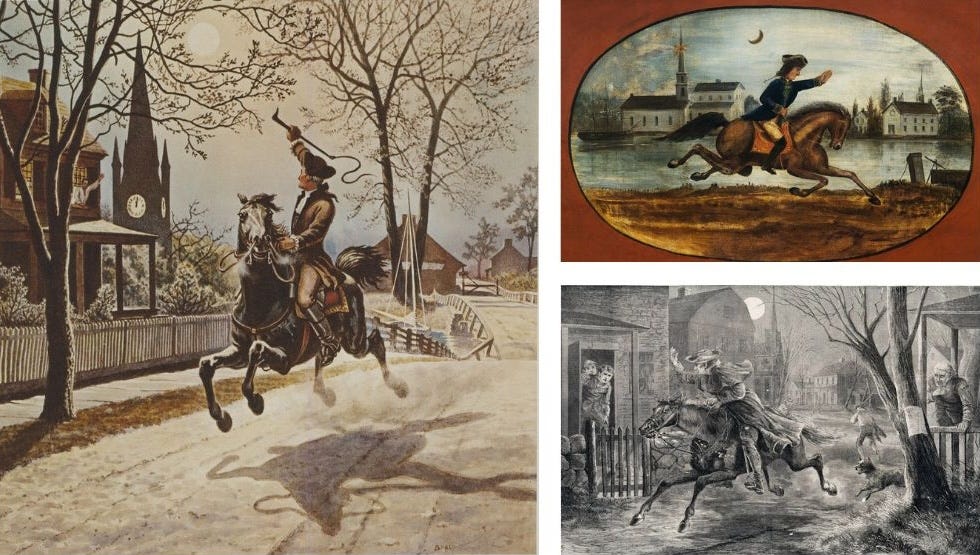
Paintings of the Midnight Ride often have similar features. Revere riding a horse at full gallop, hand raised in warning. A country lane with farmhouses and picket fences, or a road in town with churches and clock towers. People coming outside to listen, and homes lighting up with the news. But the one constant in almost every painting of the Midnight Ride is the moon, shining high and bright in the sky. Sometimes it’s a full moon, other times it’s a crescent. Even Grant Wood’s painting, which has no visible moon in the sky, assumes there’s one behind him.
Because how else was Revere going to see where he was going? It was 1775—long before Boston got gas street lamps in 1828, and even longer before Boston converted most of its gas lamps to electric lamps around 1910. A few paintings have Revere carrying a lantern, but that wouldn’t have helped much riding at a gallop.
So, was there a moon in the sky on the night of April 18, 1775? If so, was it obscured by clouds? What phase was the moon in? And does it really matter?

In 2015, I attended the Launchpad Astronomy Workshop at the University of Wyoming in Laramie. The weeklong retreat, founded in 2007 with help from NASA, is a free “crash course” in astrophysics for fiction writers, with the aim of helping to make their work more scientifically accurate. It’s mostly attended by science fiction authors, but occasionally a kids book author like me slips in. That’s me above, on an evening field trip to the University of Wyoming’s high-altitude telescope.
We talked about a lot of complex stuff at Launchpad, ranging from black holes and quasars to dark matter and dark energy to string theory and the three-body problem. But some of the things we talked about were pretty simple too, like the phases of the moon.

The moon and its phases, our instructors pointed out, are often used pretty loosely in novels—particularly novels that aren’t science fiction. When an author needs it to be bright out, there’s a full moon—even if there was a full moon a week ago in the story. (A proper full moon happens only once a month.) Or if the author is being poetic, the moon might be a “silver curve in the sky” one night, and a “pearlescent orb” the next. (There are two phases between full moons and waxing or waning crescent moons, each lasting about 3.5 days. Everybody forgets the poor gibbous and quarter moons!)
I confess, I still don’t know these phases as well as I’d like. But I do now (thanks to Launchpad!) think about how I describe the moon in relationship to the last time I wrote about it in the same book. It’s nitpicky, and probably no one but my astronomy professors at Launchpad would care, but I like getting it right.
The moon clearly played a big role in Paul Revere’s Midnight Ride. Longfellow’s poem mentions the moon five times, and almost every painting of that night has a moon in it. But what kind of moon was it?
Back in 1992, astronomers Donald W. Olsen and Russell L. Doescher of Southwest Texas State University in San Marcos figured it out. They calculated that the moon in eastern Massachusetts on the evening of April 18, 1775 was a little past full—87 percent sunlit—making it a Waning Gibbous moon. (Yay gibbous!) It was also a clear night, by Revere’s own account.
So the moon was bright and unobstructed, which made it easier for Paul Revere to see where he was going. But the two professors figured out that it was also behind him. Which was very important too, as it turns out. Remember how Revere rowed across the Charles River from Boston to Cambridge before he began his Midnight Ride? He had to do that right under the nose of the HMS Somerset, a British war ship anchored in the mouth of the river.
“For most risings of a nearly full moon, sentinels on the ship could have seen the boat. But, this time, the moon rose far enough to the south so that, 45 minutes after rising, it stood 6 degrees above the horizon at an azimuth of 31 degrees south of east,” says a Christian Science Monitor article about it. “Sentinels on the Somerset saw it coming up over Boston, not over the water. Revere slipped past in the dark.”
With a bit of lunar luck, Paul Revere’s Midnight Ride avoided a much darker outcome—both literally and figuratively!
So, back to my earlier question: Does it really matter if a painting of Paul Revere’s ride gets the moon phase right? Or a poem? Or a novel? Not really. It’s fun to know the details, but as long as the gist of it is right—the moon was bright enough that night for Paul Revere to see by—that’s all that matters. For a story, at least.
Mark Twain supposedly said, “Never let the truth get in the way of a good story.” I believe that. You want to get the important parts right, the things that really matter to history. But the little details you can fudge a bit. In fact, paying too much attention to the little things can make a story drag. And those aren’t the things you want people paying attention to anyway.
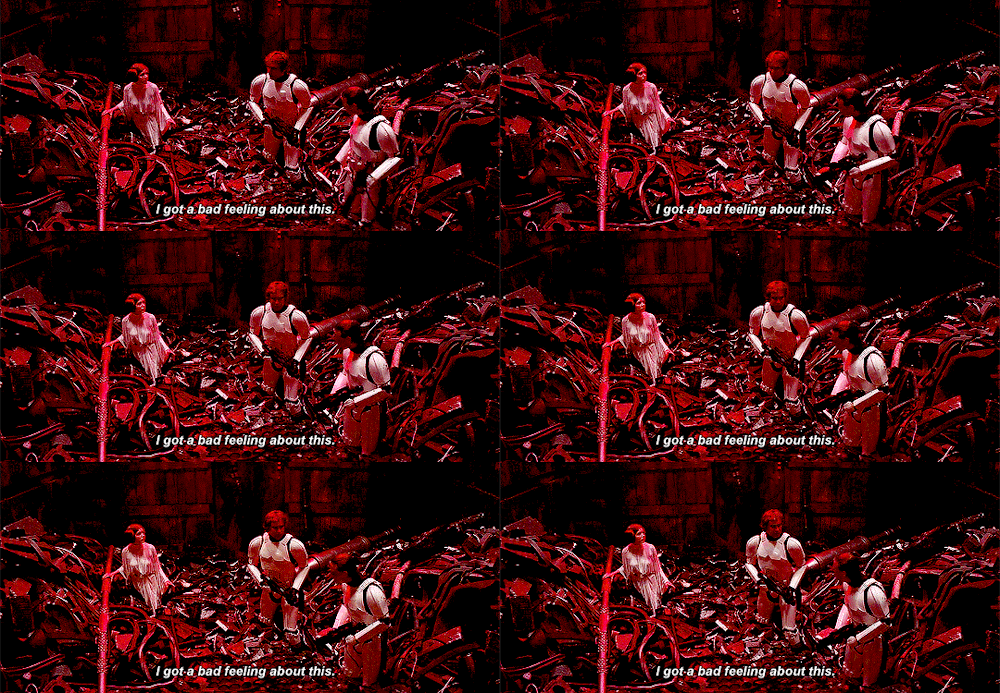
The best and funniest version of this truism I’ve ever heard is Mark Hamill talking about something Harrison Ford told him on the set of the original Star Wars. They film scenes out of order in Hollywood, and in this case, Mark Hamill noticed something wasn’t going to line up with the scene they hadn’t yet shot that came right before it in the script.
“I’m looking at continuity, and I said, ‘Wait a second. This is right after we got out of the trash compactor. Shouldn’t my hair be all wet and matted with schmutz all through it?’” Hamill said. “And he [Ford] turns to me and he says, ‘Hey, kid, it ain’t that kind of movie. If people are looking at your hair, we’re all in big trouble.’”
You can watch the clip here, on YouTube. The anecdote starts 52 seconds in. It’s hilarious—and worth watching if only for Hamill’s amazing Harrison Ford impersonation.
My novel of the American Revolution—including Paul Revere’s Midnight Ride, gibbous moon and all—will come out in 2027!
Don’t you have another book coming out first?
Why, yes, I do! Thanks for asking! My new novella, Flight, comes out September 1, 2026!

Daniela López is on a life-or-death journey.
Forced to flee her beloved home in Honduras, Dani and her family were headed north in search of safety—until a treacherous mistake ripped Dani’s parents away. Now Dani and her younger brother Carlos are on their own, and have no choice but to keep going in the desperate hope of finding their parents at the Mexico-United States border.
But to get there, they will have to ride on top of a roaring freight train known as “The Beast.”
Rickety and deadly, The Beast makes hairpin turns at terrifying speeds, shoots through dark tunnels, and stops for nothing. And there is the constant danger of being caught by gangs and kidnappers along the way.
Surrounded by hundreds of fellow refugees, Daniela will have to figure out who she can and cannot trust—and fast. Otherwise, she and Carlos don’t stand a chance of surviving…
Superfans will also find that the novella Flight shares a connection with the novel Two Degrees, but either book can be read and enjoyed first!
Pre-order your copy today!
Are you giving away any free stuff this time?
Why yes, I am! This month’s giveaway is for a class set of 25 hardcover copies of Refugee: The Graphic Novel!

Whoa! Heavy, dude! And I mean that literally. A box of these things are like the aforementioned dark matter, which scientists estimate to be five times heavier than visible matter. (Thanks, Launchpad!) Even so, I am going to ship out 25 of the things to one lucky winner!
So once again, this is a giveaway for the educators out there only. If you don’t work at a school, please don’t put your name in the drawing. There’s nothing I can do to stop you, of course. I’m just asking on your honor to leave these sets for a classroom or library to win. Thanks! (And I promise I’ll have more individual giveaways down the road.)
The contest is open to US residents only. Sorry—the price of shipping books outside the country is prohibitive for a one-man operation like me.
The deadline to enter is the end of the day on Sunday, July 26, 2026. Good luck!
What I’m reading
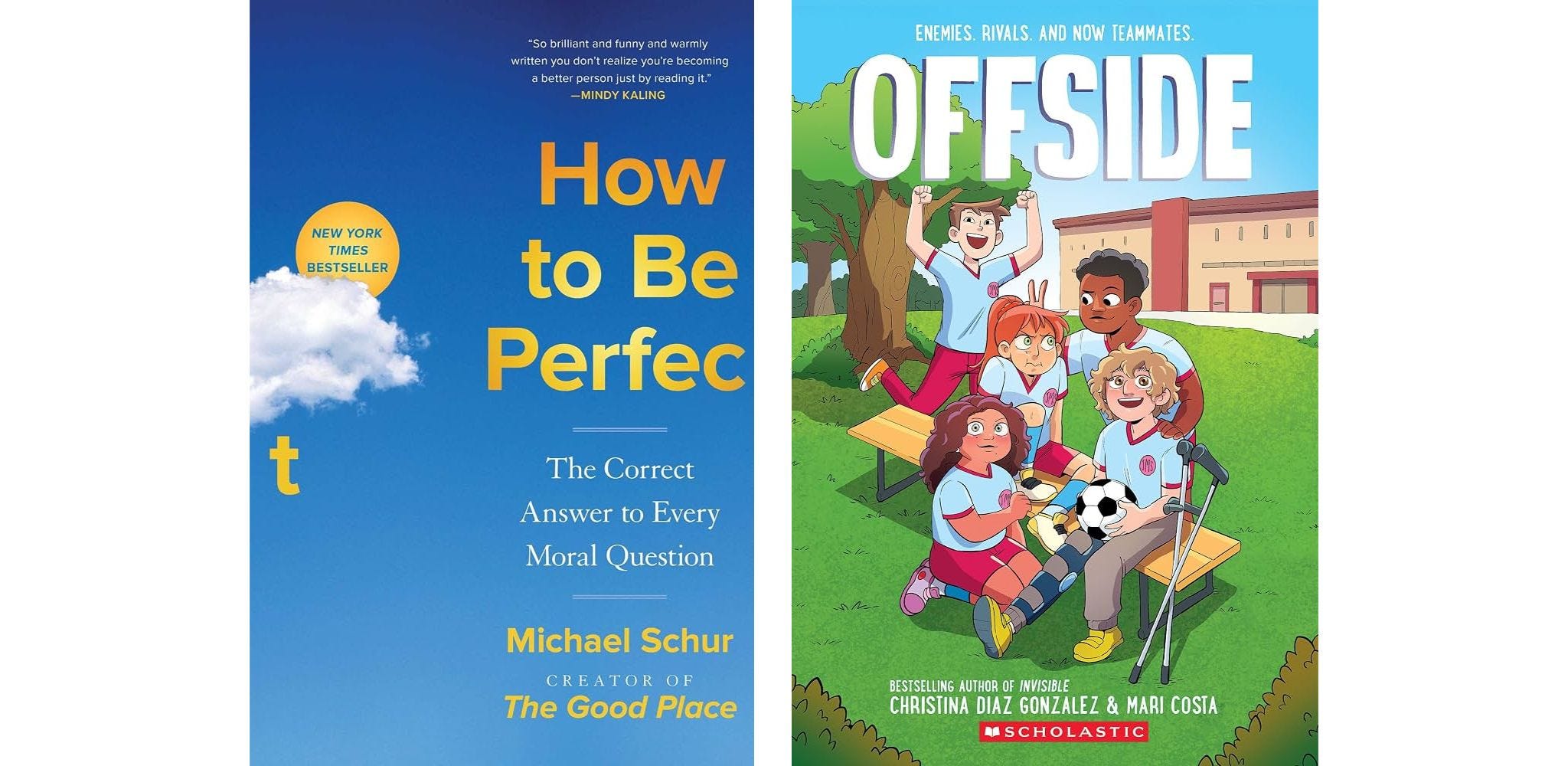
How to Be Perfect is a funny and thought-provoking book for adults by Michael Schur, the man who created the sitcom The Good Place. The tv show (which I also loved) tackled heady philosophical questions in the guise of comedy. Here, Schur maintains a light tone, but dives much deeper into major philosophies around the ideas of Being a Good Person and Doing the Right Thing. He starts by asking simple questions like “Is it okay to punch my friend in the face?” before moving on to much more complex ones like, “Why bother being good at all if no one is there to see it and there are no consequences for being bad?” Along the way he introduces and examines systems like virtue ethics, utilitarianism, deontology, existentialism, and more, applying many of the same questions to each to see how each moral philosopher would answer them. If you enjoy thinking about this kind of stuff and have been looking for a book about it written in layman’s terms, this is a really good one.
In the spirit of the World Cup, the latest edition of which wraps up this week, I thought I would spotlight Offside, a middle grade graphic novel by writer Christina Diaz Gonzalez and illustrator Mari Costa. Gonzalez is the author of middle grade books like The Red Umbrella, Invisible, and the Edgar Award-winning Concealed. Costa is the author and illustrator of the YA graphic novels Forgive Me Not and Belle of the Ball. Offside is about the struggles of a middle school soccer team becoming co-ed for the first time. Some of the boys don’t want girls on their team, and some of the players on the girls’ middle school team are mad at the young women who bailed on them for the co-ed team. Wrapped up in it all are questions of equality in men’s and women’s sports, the ideas of loyalty, friendship, and teamwork, and even an examination of the difficulties in basic communication.
The latter is perhaps the most intriguing part of the book. Just as in Invisible, Gonzalez’s cast of characters come from a variety of backgrounds. Some of them speak both English and Spanish, others just English or Spanish. Gonzalez handles this in the story by having the kids who speak Spanish first think about what they’re going to say in a thought balloon, and then say the English translation out loud in a word balloon. For English-first, Spanish-second kids, she reverses it. The effect highlights how hard it is sometimes to just talk to each other—let alone come together as a team. Which of course they do in the end, learning a lot about each other along the way. An absolute charmer, and perfect for that soccer-mad kid in your life.
That’s it for this month! If you liked this newsletter, please share it online, or with anyone you think would be interested:
And if you aren’t already a subscriber and you’d like to be, you can sign up here:
Fascinating stuff here, from the Grant Wood painting that I've never seen to the Launchpad Workshop (such interesting offerings for authors!), from the consideration of Revere's light source (this whole segment, and the upcoming book, will be a needed source for teachers) to the Ford/Hamill clip. Love the continuity of the moon theme in your dispatches.
The Paul Revere bit about the Moon is a great read for my fellow astronomers who also love their history!